Wednesday, August 3, 2011

Ooty - the Queen of hill stations


Ooty, the Queen of hill stations, is an enchanting and adventurous place to visit. Here, one finds several places which would attract nature lovers as well as trekking enthusiasts. This popular hill station has preserved the rich heritage of its successive inhabitants. Ooty is thronged by tourists all the year round. High peaks, tea gardens, churches, Lakes all can be viewed at Ooty or else one can simply shop for the famous tea or Toda handicrafts or jewellery here.


Doddabetta Peak

Standing at a height of 2623 meters, Doddabetta hill is the highest peak of the Nilgiri mountain ranges. The name of the peak is in the local vernacular in which Dodda means big and Betta means mountain; thus literally meaning the big mountain. A telescope house is situated at the top to help you get a better view of the surrounding topography. The view one gets of the Ooty town and the entire Nilgiri hill ranges is breathtaking and will remain etched in the memory of a traveler.


Glen Morgen
Located at a distance of 17 km from Ooty, Glen Morgen is a paradise for nature lovers. Glen Morgen is a dense forest and houses some of the finest specimens of trees. The fresh air that you breathe here is something rare in the cities. It is a must visit place to witness the splurge of nature in Ooty.


Ooty Boat House Lake
Built by the man who developed the hill station of Ooty, John Sullivan, this Lake is a tourist hotspot of the hill station. Constructed in 1825 to serve the purpose of an irrigation tank, the Lake later opened for general public to be also used as a boat club. Spread over an area of 2.75 km, the Lake offers a visitor a boat ride of his choice. One can take a peddle boat, a rowing boat or even a boat being rowed by the local people of the town. In the summer months one can also witness contests like boat pageants and races.

Ooty Botanical Garden
Merely 2 km from the main town, the botanical garden is the crowning jewel of Ooty. This is the most visited tourist spot of the hill station and is one of its kinds in entire India. The garden was planned in 1847 by Marquis of Tweedale to study the vegetation and plantation of the Nilgiri region. The botanical garden can boast of about 650 species of trees and plants. The rare specimens of flowers and lush green lawns and fountains would bewitch anyone by their beauty. The garden also houses a 20 million year old fossil tree. The rose garden at the Botanical Park is believed to be having the largest number of specimen of roses in India. In the month of May, the park happens to be the venue of the annual summer festival where one can view the much awaited flower show.

Children's Park
The children's park of Ooty is a pleasurable place for kids with numerous swings which are present here. Just adjacent to Ooty Boat House Lake, the park is filled with kids and their parents throughout. The well trimmed lawns and flower beds of the park, along with the backdrop of the Lake add beauty to this Children's park.

Wednesday, June 1, 2011

Akshardham Temple


Akshardham is a Hindu temple complex in Delhi, India.Also referred to as Delhi Akshardham or Swaminarayan Akshardham, the complex displays millennia of traditional Indian and Hindu culture, spirituality, and architecture. The building was inspired and moderated by Pramukh Swami Maharaj, the spiritual head of the Bochasanwasi Shri Akshar Purushottam Swaminarayan Sanstha, whose 3,000 volunteers helped 7,000 artisans construct Akshardham.

The temple, which attracts approximately 70 percent of all tourists who visit Delhi,was officially opened on 6 November 2005.It sits on the banks of the Yamuna adjacent to the 2010 Commonwealth Games village.The monument, at the center of the complex, was built off of the Vastu Shastra and Pancharatra Shastra. The complex features a large central monument crafted entirely of stone, exhibitions on incidents from the life of Swaminarayan and the history of India, an IMAX feature, a musical fountain, and large landscaped gardens. The temple is named after a belief in Swaminarayan Hinduism.


The main monument, at the center of the complex, is 141-foot (43 m) high, 316-foot (96 m) wide, and 370-foot (110 m) long,and is covered top to bottom with carved details of flora, fauna, dancers, musicians, and deities.

Designed in accordance with ancient Vedic text known as the Sthapatya Shastra, it features a blend of architectural styles from across India.It is constructed entirely from Rajasthani pink sandstone and Italian Carrara marble, and has no support from steel or concrete.The monument also consists of 234 ornately carved pillars, nine domes, and 20,000 murtis and statues of Hinduism’s sadhus, devotees, and acharyas.The monument also features the Gajendra Pith at its base, a plinth paying tribute to the elephant for its importance in Hindu culture and India's history. It contains 148 scale sized elephants in total and weighs a total of 3000 tons.


Exhibitions

Hall of Values
Also known as Sahajanand Pradarshan, the Hall of Values features life-like robotics and dioramas which display incidents from Swaminarayan's life, portraying his message about the importance of peace, harmony, humility, service to others and devotion to God.
Theatre
Named Neelkanth Kalyan Yatra, the theatre houses Delhi's first and only large format screen, measuring 85-foot (26 m) by 65-foot (20 m). The theatre shows a film specially commissioned for the complex, Neelkanth Yatra, to recount a seven-year pilgrimage made by Swaminarayan made during his teenage years throughout India.

Musical fountain
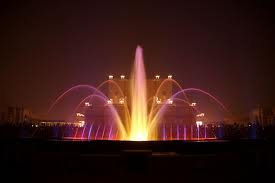
Known as the Yagnapurush Kund, it is India's largest step well. It features a very large series of steps down to a traditional yagna kund. During the day, these steps provide rest for the visitors to the complex and at night, a musical fountain show representing the circle of life is played to an audience which is seated on the same steps.[17] The fountain is named after the founder of the Hindu organization, Shastriji Maharaj.[18] The fountain measures 300 feet (91 m) by 300 feet (91 m) with 2,870 steps and 108 small shrines. In its center lies an eight-petaled lotus shaped yagna kund designed according to the Jayaakhya Samhita of the Panchratra shastra.
Garden of India
Also known as the Bharat Upavan, this garden has lush manicured lawns, trees, and shrubs. The garden is lined with bronze sculptures of contributors to India's culture and history. These sculptures include children, women, national figures, freedom fighters, and warriors of India. Of these figures, the more notable figures include the national figures such as Mahatma Gandhi.

Thursday, May 26, 2011

Caves of India

Ajanta and Ellora Caves
India's most popular and widely recognized caves, the Ajanta Ellora caves are carved into hillside rock quite in the middle of nowhere, in northern Maharastra. These caves are simply awe inspiring. Words can't describe how magnificent they are. There are 34 caves at Ellora dating from between the 6th and 11th centuries AD, and 29 caves at Ajanta dating back to between the 2nd century BC and 6th century AD. The caves at Ajanta are all Buddhist, while the caves at Ellora are a mixture of Buddhist, Hindu and Jain.

Elephanta Island Caves
If you can't make it to the Ajanta or Ellora caves, the Elephanta Island caves just off the coast of Mumbai may be the next best thing. They're one of the most popular tourist attractions in Mumbai. There are seven ancient caves hand carved out of rock in a similar manner to the Ajanta and Ellora caves, but on a smaller scale. They're believed to date back to between 450 and 750 AD. The main cave has a number of stunning large sculptured panels depicting the Hindu god of creation and destruction, Lord Shiva. Get there by taking a ferry from the Gateway of India, in Colaba.

Badami
The attractive cave temples are the highlight at Badami, in northern Karnataka. There are four temples, open daily from dawn til dusk. One cave is dedicated to Lord Shiva, two to Lord Vishnu, and the remaining smaller one is a Jain cave temple. They overlook the 5th century Agastyatirtha Tank and the waterside Bhutanatha Temples, which add to their appeal.


Udayagiri and Khandagiri Caves
The outskirts of Bhubaneshwar, one of the top tourist destinations in Orissa, is an excellent place to explore caves dotted all over the landscape. Udayagiri (Sunrise Hill) has the most interesting caves, and if you don't mind getting up early it's worthwhile to arrive there at dawn for an almost spiritual experience. Wander around and you'll discover many ornately carved caves, thought to be occupied by Jain asthetics. They include the Tiger Cave and the large and revealing Queen's Palace Cave. Khandagiri is across the road and its worth a visit for its superb vistas over the city, as well as its few caves.

Jammu and Kashmir
There are two important India caves dedicated to Lord Shiva in Jammu and Kashmir, both of which are popular with pilgrims. Shiv Khori is located near Ransoo, in the Swalik Hills around 110 kilometers northwest of Jammu (it's possible to take a public bus there). It's a kilometer-long cave with a natural Shiva lingam at the end, made out of a stalagmite. Pilgrims flock there during the Shivaratri festival in February/March. On Mount Amarnath, around 140 kilometers from Srinagar in Kashmir, there's the Amarnath caves and temple. A famous Hindu shrine, it also has a Shiva lingam made out of a stalagmite, but this one is an ice one. Hundreds of thousands of pilgrims visit it during the Amarnath Yatra, in July/August.

Tabo
If you're keen on remote meditation caves in India, you might want to head to Tabo. Located in the Spiti Valley, in high altitude Himachal Pradesh, the rugged, rocky ridge above the town is filled with caves that the local Buddhist lamas meditate in. There are dozens of caves, both large and small, all dug into the mountain by hand. You can walk up to them and spend some time in quiet contemplation.

The Many Caves of Meghalaya


Meghalaya in India's north east has the largest number of known caves in the country -- currently 1,284. One cave is an incredible 22 kilometers long!


Undavalli and Mogalarajapuram Caves
In the Andhra Pradesh cultural heartland, not far southwest of the bustling city of Vijayawada, you'll find the well preserved 7th century Undavalli cave temples. Their backdrop of palmtrees and rice paddies provides a tranquil contrast. Inside you'll find shrines dedicted to the all powerful Hindu trinity -- Shiva, Vishnu, and Brahma. However, it's the huge reclining statue of Lord Vishnu on the third floor that really stands out.

Trichy Rock Fort Temple and Pallava Caves
The Rock Fort Temple is the focal point of Trichy, one of the top 5 places to see south Indian temples. It was built by the Nayaks of Madurai, in spectacular style on a rocky outcrop 83 meters (237 feet) above the city. The panoramic view over town is memorable, particularly at sunset. However, it was the Pallavas who firstly cut small cave temples into the southern face of the smooth rock. They're still there, and it's possible to visit them. One is on the way to the Uchi Pillayar Temple.

Dungeshwari Cave Temples
If you're on the Buddhist trail, you'll no doubt want to check out the Dungeshwari cave temples also known as the Mahakala caves. where the Buddha spent a number of years before making his way to Bodhygaya and finally attaining enlightenment. You'll most likely be invited in to meditate. It's a wonderful spot to enjoy the serenity and spirituality.

Sunday, May 22, 2011

Kullu - Manali


The Kullu valley has an ancient town in its lap called Manali. Surrounded by towering peaks at an arm length, Manali's major asset is its proximity to the snowline. It is a flourishing orchard industry, a popular honeymoon destination and trailhead for numerous treks as well as a great countryside ideal for adventure sport lovers.

Manali literally means the 'Home of Manu'. Manu is the mythological character who is supposed to have survived when the world was drowned in Flood. He then came to Manali and recreated human life. Thus, the area of Manali is sacred and Hindus treat the temples over here as pilgrimage.

The valley of gods, as the Kullu valley has come to be known, is perhaps the most delightful region in the western Himalayas. The ancient Hindus regarded it as the furthest limit of human habitation - Kulantapitha, and its original name finds mention in the epics, the Ramayana and the Mahabharata as well as Vishnu Purana.

Like a slender delicate-hued fern glistening in the morning dew, the valley spreads out its charm on either side of the upper reaches of the river Beas. Running north to south, the main river valley is only 80 km long and 2 km at its broadest, yet a fairly wide area is open to the visitors to enjoy the spectacle of variegated mountain scenery.

In the spring Kullu is at its most colorful with pink blossoms and white flowers while the higher slopes are aglow with gorgeous rhododendrons. With autumn, clear blue skies return and fields and forests alike show wonderful tints of crimson and ochre. By December, there is no greenery except the majestic pines and cedars in the forests. In winter the hillsides are flanked in white.

Situated on the banks of the Beas, Kullu, the headquarters of the district, serves as a nerve centre of the valley and is the starting place for a number of treks. The deodar-fringed grassy maidan, Dhalpur, is a stage for many colorful fairs.

Places to see in Manali

Kothi

A quiet but picturesque spot. The Rest House overlooks the narrow valley and commands views of the mountains. Below Kothi, for more than a kilometer the river Beas flows through a deep gorge, almost a subterranean passage, 30 meters or more in depth, and the cliffs which flank both sides of the canyon are a favorite haunt for rock pigeons. The site of the bridge provides an interesting historical episode in the early annals of Kullu.

                                                                                     Solang Valley

A splendid valley between Manali and Kothi which offers views of the glaciers and snow-capped mountain peaks. The plateau is frequently used for holding camps by the trekking parties. Good skiing slopes of the Mountaineering Institute. Venue of annual winter carnival from February 10-14. Bus service up to Palchan village (10 km) and then by jeep or on foot.

Rahla Falls


Two km from Kothi. Here the river Beas hurtles down from a height of about 50 meters. Charming spot for picnics.


                                                                                                                                      Manali Sanctuary
A bridle path from the Manali log huts goes past the Dhoongri Temple and wanders into the dense deodar, kail, horse chestnut, walnut and maple forest which is a part of this sanctuary. Camping overnight in tents at Lambadug or Galiani Thatch is possible.

Lush green alpine pastures and glaciers lie beyond Galiani Thatch. Musk deer, monal and brown bear are often spotted. For those who venture still further into the glacier zone in summer, there are herds of ibex.

Hadimba Temple


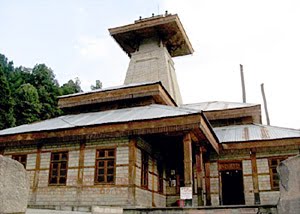
Hadimba or Dhungiri temple in Manali is one of the most important temples in the region. This four-story wooden temple is located in the middle of a forest called the Dhungiri Van Vihar.


                                                                                                                  Gadhan Thekchoking Gompa

This Gompa dominates the Tibetan area around the bottom of the Mall in Manali. The Tibetan refugees built the Gompa in the late 1960's. The Gompa is covered with brightly colored frescoes and a mid size Buddhist statute. It also carries a list of the martyrs killed in occupation of Tibet of 1987 to 1989.

Old Manali


The old Manali area is located some 3-km from the present day Manali. The old Manali is covered with guesthouses, which look ancient now, and orchards where the livestock move at will.


                                                                                                                                Temple of Manu


Slippery stones paths lead through the old village houses up to the temple of Manu. Manali is named after the sage Manu who meditated when he came in this area.


Tibetan Temple


Tibetans have a base in Manali too. There is a large modern Tibetan temple to the South of the bus stand and also a small handicrafts center.


                                                                                                                               Arjun Gufa


On the left bank of the Beas, 5-km from Manali near the village of Prini, is the 'Arjun Gufa' or the cave of Arjuna. In here Arjuna practiced austerities to get Pashupata Ashtra or weapon from Lord Indra.


Around Manali


                                                        Rohtang Pass

51 km. At an altitude of 4,112 metres on the highway to Keylong, the pass affords a wide-spread panorama of mountain scenery. In place of the pinnacled hills, sheltered valleys and cultivated tracts, the eye meets a range of precipitous cliffs, huge glaciers and piled Moraine, and deep ravines. Almost directly opposite is the well defined Sonepani glacier, slightly to the left are the twin peaks of the Geypang, jagged pyramids of rock, snow streaked and snow crowned.

The Beas river rises near the crest of Rohtang from a block of Mica-Schist. The pass normally opens for traffic after mid-June and officially closes in November. To its left, 200 metres higher, is the little lake of Sarkund (Dashair) visited by a number of people, the general belief being that a bath in these waters effects a cure of all bodily ailments-real or imaginary. 10 km before Rohtang is the barren-landscape of Marhi which hums with activity during summer and autumn months because almost everyone stops here for refreshments.

                                                                Keylong

117 km. A fair sized village amidst green fields of barley and buckwheat, Keylong is the headquarters of the Lahaul and Spiti district, surrounded with brown hills and snowy heights. Karding Monastery overlooks Keylong and is 3.5 km across the Chandra river while Shashur Monastery is about 1 km. HPTDC Tourist Bungalow.

                                                   Triloknath and Udeypur

These are two important places of pilgrimage in Pattan Valley. At Triloknath is a six armed image in white marble of Avalokiteshvara, Bodhisattava. Visitors will enjoy crossing the Chandra-Bhaga river and the trek of 3 km to reach the destination. The temple of Marikula at Udeypur is highly remarkable for its wood carvings. Udeypur is 166 km from Manali.

Friday, May 20, 2011

Qutub Minar: The Tallest Monument in India

Qutub Minar
The tall and ever attractive monument of Delhi which can be seen from most parts of the city is called the Qutab Minar. Every body has the same question when one sees the structure for the first time. The question that is often being put up is "Why the monument is that big?" or "Was there any specific reason to build such a tall building or it was just a wish of the person who built it?" Well, the exact reason is assumed to have something related to commemorating the victory. Mughals used to build victory towers to proclaim and celebrate victories. Some say the minaret was used to offer prayer but it is so tall that you can hear the person standing on the top. Also, the minaret is not joined on to Qutuddin's mosque and the Iltutmish's mosque.


Qutab Minar is among the tallest and famous towers in the world. The minaret is 234 feet high and the highest individual tower in the world. Other towers in the world are the Great Pagoda in Pekin, China and the Leaning Tower of Pisa in Italy but these towers are not as high as the Qutab Minar in Delhi.

According to history books, the minar was started by Prithviraj or his uncle Vigraharaja who won Delhi from the Tomar Rajputs. However, it is assumed and historians believe that Qutubuddib and Iltutmish finished it though the minar may have been commenced by Prithviraj or Vigraharaja. The minar was completed in 1200 A.D and since then the tall structure has been there upright and ever beautiful keeping an eye to Delhi just like a sentry. When Alauddin returned from the wars in the Deccan, he had this thought in mind that he would build a victory tower somewhat similar to the Qutab Minar. The ruins of this very initiative can be seen adjacent to the Qutbuddin's mosque because Alauddin died at the very start of the construction work and no one carried on to finish the initiative taken by Alauddin.

Qutab Minar is another great masterpiece of Mughal architecture. It has a number of floors or storeys which has beautiful carvings like the one on the tomb of Iltutmish. There are inscriptions all round the tower and these inscriptions reveal that Iltutmish finised the tower. The structure of the wall is made as such that it widens from top to bottom, just to make the minar stronger.

Moving upstairs inside the minar will give you a wonderful experience and counting the stairs is always a fun for visitors. It has 378 steps which takes good amount of energy to reach at the top. The top of the tower gives an insight to Delhi because you get to see the bird's eye view of the city. To point a few sight seeing from the top, you will find views of the Hauz Khaz on the left and the walls of the Jahanpanah and Siri on the right. It was this very top of Qutab Minar that was used by Khilji and Tughlaq kings to watch the wild Mongol hordes when they threatened Delhi. The top also served as the watch top for Tughlaq who watched Timur's army camp on the Wellingdon Airport. Other important monuments that is visible from the top are the walls of Tughlaqabad, Humayun's Tomb, Purana Qila, Firoz Shah Kotla and Jama Masjid.

The minar did receive some damage because of earthquakes on more than a couple of occasions but was reinstated and renovated by the respective rulers. During the rule of Firoz Shah, the minar's two top floors got damaged due to earthquake but were repaired by Firoz Shah. In the year 1505, earthquake again struck and it was repaired by Sikandar Lodi. Later on in the year 1794, the minar faced another earthquake and it was Major Smith, an engineer who repaired the affected parts of the minar. He replaced Firoz Shah's pavilion with his own pavilion at the top. The pavilion was removed in the year 1848 by Lord Hardinge and now it can be seen between the Dak Bungalow and the Minar in the garden. The floors built by Firaz Shah can be distinguished easily as the pavilions was built of white marbles and are quite smooth as compared to other ones.

The minar is not that erect as it used to be because of wears and tears over the past several years. Closely looking at the mina rives you an idea that it is somewhat tilled towards one side. The minar is very sincerely looked after by the authorities much like the same as other historic monuments in the country.

Friday, April 8, 2011

The Sun Temple

The Sun Temple at Konark in Orissa is one of the most famous tourist places attracting a large number of tourists.

Sun Temple


The Sun Temple at Konark is a magnificent structure with its beautiful temple architecture. The temple stands majestically on the sandy coast of the Bay of Bengal and it is one of the most popular tourist destinations in the state of Orissa. The Sun temple in its solitary grandeur is an eloquent testimony of a gracious and mysterious past.

This famous temple is located in the natural surroundings of the village of Konark which is nearly 35 Km to the north of Puri. The place is surrounded with natural vegetation that grow in the sandy soil in an unspoilt environment. Konark experiences a moderate climate which makes it easy for the tourists to visit the place round the year.

The temple is designed in the shape of a giant chariot with seven pairs of horses pulling the chariot that has twenty four wheels. The Sun temple with its stunning monuments and exquisite stone carvings on the walls is a culmination of Orissan temple architecture.

The temple was built by King Narasimhadeva-I of Ganga Dynasty in the 13th century which marks the highest point of achievement of Kalinga architecture. There is an endless wealth of decoration from minute patterns to large size free standing sculptures in the temple. There are beautiful and natural cut animal and human figures in and around the temple.

The Sun Temple at Konark hosts annual Dance Festivals featuring the traditional dance forms of India

Places Around Konark:


1. The sea beach at Konark is at a distance of nearly 2 miles from he temple. It is one of the beautiful beaches and is known as 'Lovers Paradise". Early morning is the best time to visit the beach to view the beautiful sunrise from the Bay of Bengal.

2. There is a small museum outside the temple run by the Archeological Survey of India. It has beautiful collection of sculpture of the temple ruins.


Shopping:

A variety of local handicrafts are available in the local shops. Pattachitra paintings, stone carvings, terracota, articles made of bamboo and handloom textiles of the local area are available in the shops. The attractive handwork of Pipli (a small village which is at a distance of 45 Km from Konark), which is an applique work, is very popular.


To Reach:

By Air: Bhubaneswar and Puri are the nearest airheads
By Rail: Bhubaneswar and Puri are the nearest railheads which are well connected with all major cities in India
By Road: Conveniently connected to Puri and Bhubaneswar. 

Saturday, April 2, 2011

Taj Mahal - The Symbol of Love

Tajmahal is the famous tourist attraction place and one of the seven wonders of the world.Lets have a look at its specialties.

The Taj Mahal
Everyone knew,TajMahal is a symbol of love built by the famous king Shahjahan in memory of his beloved wife Mumtaz Mahal.She died in 1631 after her 14th child Govhara.
Its situated at Agra in Delhi.We can see some more specialties of it:

1. The tomb of Mumtaz is present in the middle of TajMahal with 4 pillars outside the dome shaped monument.The top of the dome has lotus shaped carving inside.

2. The monument is constructed with white marble stones fully and it has paintings of different plants,leaves and flowers.Also,jasper,jade and crystal turquoise,sapphire,pearls etc type of stones are used.

3. In the entrance,some verses from Quran has been carved.

4. Surrounding Taj Mahal,is the large garden with 16 water ponds present.These ponds separate the garden and in-between them pathway is constructed.

5. In front of TajMahal there is a pond,which shows the image of it like a mirror.Its called lotus pond and never get dried.There are many trees and plants which look fertile.Now a days,because of not maintaining it properly,we can't find those.

6. There is also a mosque and a building for guests to stay next to TajMahal.

People must visit this place atleast once in lifetime.Its worth to see.These days we cant find any husbands doing such great things for wives.So,have a visit when you find time.